Absolute Predict · Blog
The 2026 NFL Betting Boom: Sportsbooks, & Prediction Markets
2026 NFL betting, NFL betting boom, NFL sports betting, NFL sportsbooks, NFL prediction markets, NFL betting trends, betting 2026, NFL odds, NFL gambling
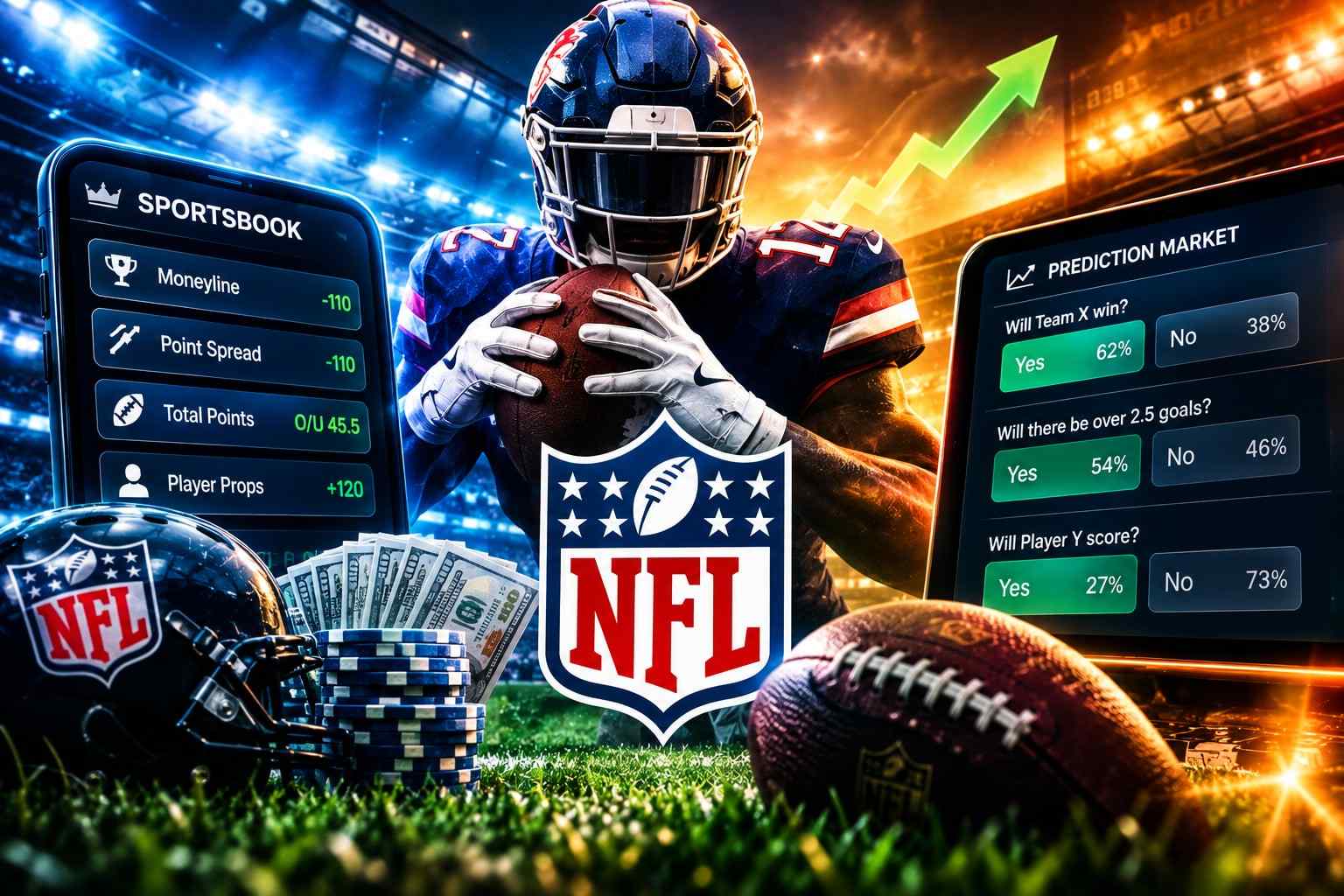
The NFL is back, and apparently football was not enough.
Now the games come with point spreads, moneylines, totals, player props, same-game parlays, prediction contracts and enough numbers to make an accountant ask for a lie-down.
The 2026 NFL season is shaping up to be one of the biggest betting years yet, with analysts at Citizens estimating around $35 billion in football betting handle through traditional U.S. sportsbooks. At the same time, prediction markets are expanding rapidly, bringing a new style of event trading into the football economy.
And this is no longer a side story.
Betting has become part of the way many fans consume the NFL.
Why Is NFL Betting So Big?
The answer begins with the structure of the league.
Unlike a football league such as the Premier League, where teams play 38 league matches over a long season, an NFL regular season contains 17 games per team across 18 weeks.
That scarcity makes individual games feel enormous.
One Sunday can dramatically alter a team's playoff chances.
For a newcomer, the basic idea is this: teams first play the regular season, then the strongest teams advance to the playoffs, with the postseason eventually producing the Super Bowl champion.
Every game therefore carries a little more weight.
And when every game matters, bookmakers have plenty of material to sell.
The 2026 Season Started With a Betting Dream
The defending Super Bowl champion Seattle Seahawks opened the season against the New England Patriots on September 9 in a rematch of Super Bowl LX.
Seattle won that opener 13-10, beginning its title defence with a victory.
The following night, the NFL staged its first regular-season game in Australia, with the San Francisco 49ers beating the Los Angeles Rams 27-7 in Melbourne.
For the NFL, that international expansion is about much more than sightseeing.
More countries mean more viewers.
More viewers mean more commercial opportunities.
And, increasingly, more potential betting customers.
The 2026 schedule features a record nine international games across four continents, seven countries and eight stadiums, with new destinations including Melbourne, Paris and Rio de Janeiro.
The league is, quite literally, taking the product around the world.
The Sportsbook Is No Longer the Only Player
Traditional sportsbooks remain at the heart of NFL betting.
A sportsbook allows a bettor to wager on outcomes such as:
- Who wins the game
- Point spread
- Total points
- Player touchdowns
- Passing yards
- Receiving yards
- Parlays
- Same-game combinations
The point spread is particularly important for newcomers.
If a team is listed at -6.5, it must win by seven or more points for that side of the spread to cash.
If the underdog is +6.5, it can lose by six or fewer points or win outright, and still cover.
It sounds complicated for about five minutes.
Then football fans start arguing about half-points at dinner.
Prediction Markets Are Changing the Conversation
The bigger disruption in 2026 may be coming from prediction markets.
Platforms such as Kalshi and Polymarket have pushed event contracts into sports, allowing users to trade positions based on whether an event will happen.
The rapid growth has attracted major attention, with prediction-market activity rising sharply as the NFL season begins. Analysts expect the broader prediction-market industry to generate enormous trading volumes, while companies including DraftKings and Robinhood are also expanding their presence in the space.
The difference is important.
A traditional sportsbook generally presents you with odds.
A prediction market presents an event contract whose price reflects the market's perceived probability.
So instead of simply asking:
"Who wins?"
the market can effectively ask:
"What probability does the market currently assign to this happening?"
That turns sports betting into something resembling financial trading.
Football has officially found another way to make Sunday complicated.
Why the Industry Is Fighting Over It
The rise of prediction markets has created a regulatory argument that is becoming almost as competitive as the football itself.
Supporters argue that event contracts belong under federal financial-market regulation.
Critics, including gambling-industry groups and sports organisations, argue that sports contracts look and function too much like gambling and should face the same safeguards as conventional sportsbooks. The NFL has raised concerns about sports-related prediction markets and integrity, while legal battles continue over where these products should sit within the regulatory system.
There is another wrinkle.
A recent report found that major sportsbook operators are themselves becoming involved in prediction-market liquidity, blurring the supposedly neat line between "sportsbook" and "prediction market." Barron's reported that FanDuel's parent company Flutter disclosed market-making activity on a major prediction platform identified as Kalshi.
So the new kid on the block may have some very familiar people behind the counter.
What Is Driving the Betting Boom?
Several forces are working together.
More legal access. Sports betting is now available in much of the United States, although rules still vary considerably from state to state.
Better technology. Betting apps make it possible to place wagers almost instantly.
Live betting. Fans can wager while games are happening, with prices changing after every major play.
Player props. Bettors can now focus on individual performances rather than simply picking winners.
Parlays. Multiple selections can be combined into one wager, producing much larger potential payouts but also making it substantially harder to win.
Prediction markets. New platforms are attracting people who might think of themselves as traders rather than gamblers.
And then there is the NFL itself.
The league has turned its season into a global entertainment product, with games spread across television, streaming platforms and international markets.
The betting industry is simply following the audience.
But Bigger Does Not Mean Safer
This is where the shiny numbers need a little rain.
A betting boom is good news for sportsbooks.
It is not automatically good news for bettors.
The more betting options become available, the easier it becomes to bet more often—and sometimes without thinking.
A bettor can lose a spread, chase it with a player prop, throw a parlay into the next game and then convince himself that Monday Night Football will repair the damage.
It rarely works that neatly.
The NFL does not know you lost your Sunday accumulator.
It does not owe you a comeback on Monday.
And your sportsbook certainly did not receive a memo promising one.
The Smartest NFL Betting Trend May Be Discipline
For newcomers, the most important lesson is surprisingly boring.
Understand the market before betting it.
Know what the spread means.
Understand the difference between a moneyline and a total.
Know how parlays multiply risk.
Check the rules surrounding prediction-market contracts.
Most importantly, decide how much money you can afford to lose before you start.
The American Gaming Association promotes responsible gaming principles built around setting limits and understanding the risks of gambling.
That matters in a market becoming increasingly sophisticated at making betting feel effortless.
The button is easy to press.
The consequences are not always so easy to reverse.
Where the NFL Betting Boom Goes Next
The 2026 season could prove to be an important turning point.
Traditional sportsbooks are still enormous, but prediction markets are forcing the industry to rethink what a sports wager actually looks like.
A football fan may soon move between sportsbook odds, player props, live markets and event contracts without thinking much about the distinction.
For the industry, that means more competition.
For bettors, it means more choice, and potentially more ways to lose money if that choice is handled carelessly.
The NFL has already mastered the art of making a three-hour game feel like an appointment with destiny.
The betting industry has simply figured out how to put a price tag on every chapter.
Jeremy Floyd
Published Sep 12, 2026
Focus Keyword
Description
2026 NFL betting, NFL betting boom, NFL sports betting, NFL sportsbooks, NFL prediction markets, NFL betting trends, betting 2026, NFL odds, NFL gambling
Category
No comments yet. Be the first to comment!