Absolute Predict · Blog
The Black Sox Scandal: The Baseball Fix That Shook America
The Black Sox scandal saw eight Chicago White Sox players accused of fixing the 1919 World Series. Here is the story behind baseball’s most infamous scandal.
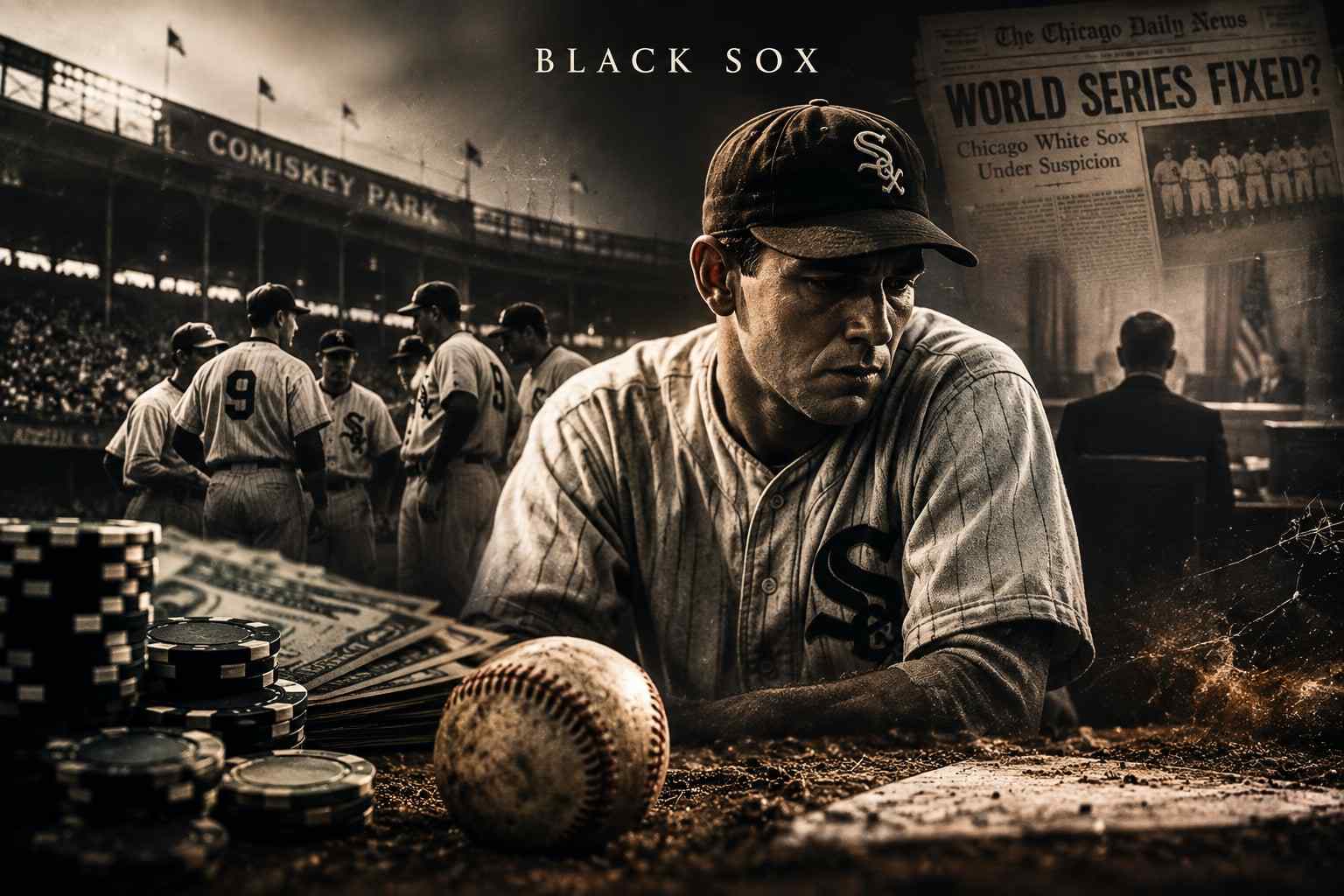
Baseball had a problem in 1919, and it was not a bad pitching rotation.
It was money.
The Black Sox scandal remains one of the most notorious episodes in sports history: eight Chicago White Sox players were accused of taking money from gamblers to deliberately lose the 1919 World Series against the Cincinnati Reds.
The scandal became so damaging that it changed how professional baseball was governed and helped establish the hard-line attitude toward gambling that still follows the sport today.
What Actually Happened?
For readers unfamiliar with baseball, the World Series is essentially Major League Baseball's championship showdown. The American League and National League champions meet to decide who rules the baseball world.
In 1919, the Chicago White Sox were heavily favoured to beat Cincinnati.
Instead, Cincinnati won the best-of-nine series five games to three. That was not necessarily suspicious by itself — favourites lose all the time. Sport has a wicked sense of humour.
The problem was what happened behind the scenes.
Several White Sox players had agreed with gamblers to deliberately undermine the team's chances in exchange for money. The alleged fix involved eight players: Eddie Cicotte, Claude “Lefty” Williams, Shoeless Joe Jackson, Happy Felsch, Chick Gandil, Swede Risberg, Buck Weaver and Fred McMullin.
The World Series That Would Not Stay Buried
The scandal did not explode immediately.
Rumours grew after the Reds won the championship, but it was not until 1920 that the allegations triggered a major investigation. Several players eventually gave evidence about the scheme, and eight were indicted on conspiracy charges.
The details were ugly.
Cicotte, one of Chicago's best pitchers, admitted accepting money and described deliberately compromising his performance. Jackson's involvement remains one of the most debated parts of the story, particularly because his actual performance during the Series was not remotely that of a man enthusiastically throwing games.
That ambiguity helped turn Shoeless Joe Jackson into the scandal's most controversial figure.
Eight Men Went to Court, Then Baseball Had Its Own Verdict
In 1921, the eight players went on trial.
And, rather remarkably, they were acquitted.
You might think that would have been the end of it.
It wasn't.
Baseball had recently appointed Kenesaw Mountain Landis as its first commissioner, partly amid the need to restore public confidence after the scandal. Landis took an extraordinarily hard line and permanently banned all eight players from professional baseball.
In other words, the courtroom said one thing and baseball's new sheriff said another.
Landis had made his position unmistakable: the integrity of the game mattered more than the legal outcome.
Why Were They Called the Black Sox?
The nickname stuck because the players were members of the Chicago White Sox, yet their reputation had been stained by the fixing scandal.
The irony was almost too perfect.
The White Sox had entered the 1919 World Series as one of baseball's finest teams. They left it carrying a nickname that would become synonymous with cheating, gambling and betrayal.
And the stain proved remarkably difficult to wash away.
Shoeless Joe Jackson's Complicated Legacy
No player from the scandal remains more famous than Shoeless Joe Jackson.
Jackson was a brilliant hitter with a career batting average of .356, but his involvement in the Black Sox affair ensured that his playing career ended at 32. His lifetime ban also kept him outside the Baseball Hall of Fame.
His supporters have long argued that Jackson's actual role was less straightforward than the scandal's mythology suggests. But baseball has never reversed the ban.
As of 2026, the Black Sox remain permanently excluded from organized professional baseball under the historical ruling.
The Scandal Changed Baseball Forever
The Black Sox affair did more than embarrass the White Sox.
It changed baseball's relationship with gambling.
The scandal contributed directly to the creation of the commissioner's office and the appointment of Landis, whose authority was deliberately broad. His lifetime bans sent a message that would echo through baseball for generations: tampering with the integrity of the game was considered a crime against the sport itself.
More than a century later, the Black Sox scandal still matters because the basic issue has not disappeared.
Sports are built on trust.
Fans can accept a missed catch, a terrible referee decision or a striker blasting the ball into row Z. What they cannot accept is discovering that the contest they invested their emotions in was secretly being played to a different script.
That is why the Black Sox story refuses to fade.
The uniforms changed. The stadiums changed. The money became much bigger.
But the lesson remains stubbornly simple: once spectators stop believing the game is genuine, the game itself starts to lose its value.
Jeremy Floyd
Published Sep 16, 2026
Focus Keyword
Description
The Black Sox scandal saw eight Chicago White Sox players accused of fixing the 1919 World Series. Here is the story behind baseball’s most infamous scandal.
Category
No comments yet. Be the first to comment!