Absolute Predict · Blog
10 Football Referee Rules Most Fans Don't Know
Discover 10 surprising football referee rules, from offside exceptions and goalkeeper time limits to penalty rebounds, decisions after the final whistle.
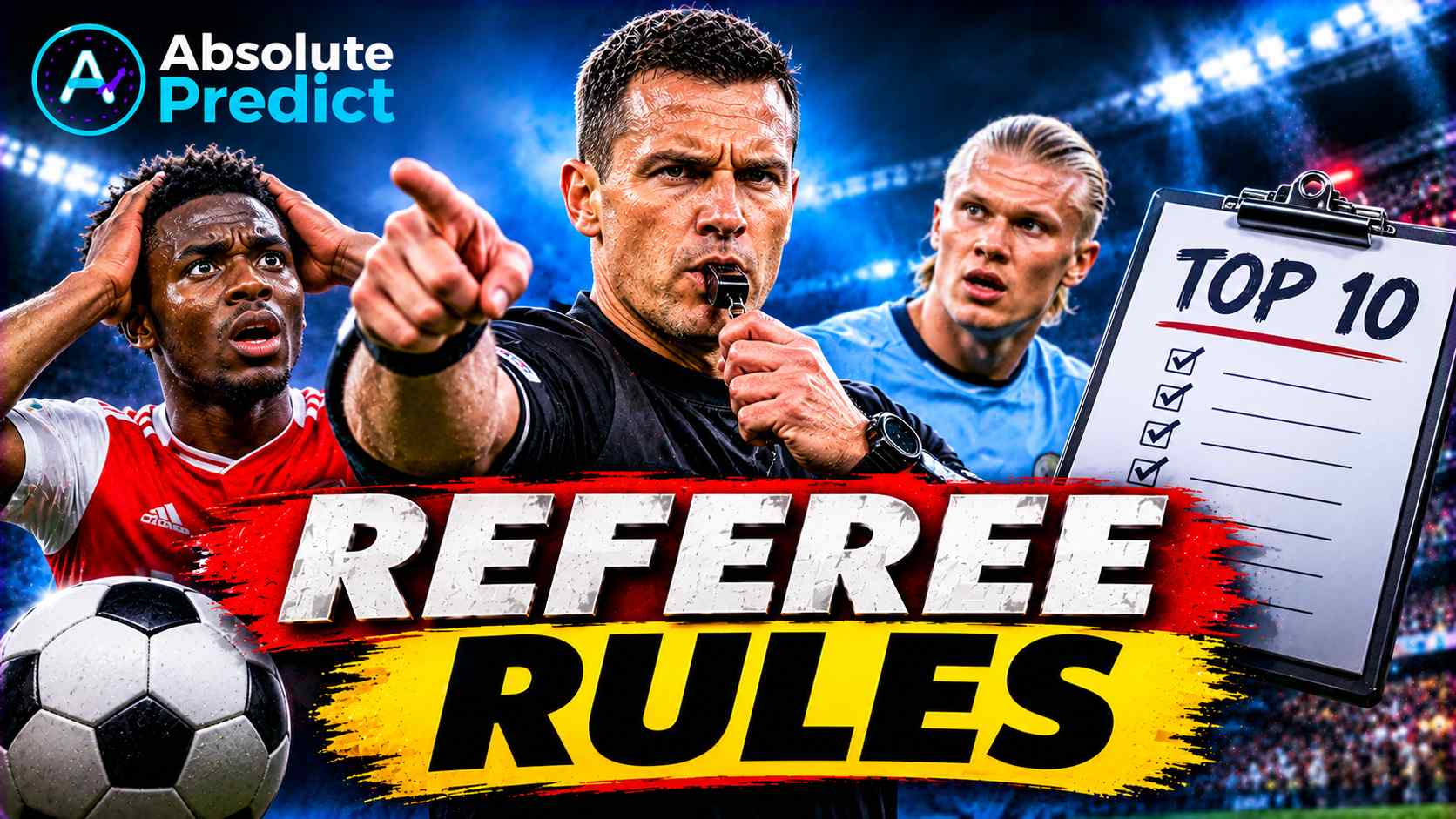
Football fans know the obvious rules: a player cannot handle the ball deliberately, a foul can lead to a free kick, and a red card means an early shower. But the Laws of the Game contain plenty of less familiar details that can leave even regular viewers surprised.
Can a referee award a penalty after the final whistle? Can a player be offside from a throw-in? Is a goalkeeper allowed to hold the ball indefinitely? Can a referee change a decision after play has restarted?
The answers are not always what supporters expect.
Some of these rules are rarely seen. Others appear during ordinary matches but are misunderstood because television coverage tends to focus on the incident rather than the precise law behind the referee's decision.
Understanding them offers a different perspective on the game. It also helps explain why referees sometimes make decisions that look strange at first glance but are entirely consistent with the official Laws of Football.
Here are ten lesser-known referee rules that every football fan should know.
1. A Player Cannot Be Offside Directly From a Throw-In, Goal Kick or Corner Kick
This is one of the most surprising rules in football, particularly for fans who understand the basic offside law but are unfamiliar with its exceptions.
Normally, an attacking player can be penalised for offside if they are in an offside position when a team-mate plays the ball and subsequently become involved in active play.
However, there are three specific situations in which a player cannot be penalised for receiving the ball directly from a restart:
- A throw-in.
- A goal kick.
- A corner kick.
Imagine Liverpool taking a throw-in deep inside Manchester United's half. An attacker could stand behind the opposition's defensive line, receive the ball directly from the throw and continue towards goal without committing an offside offence.
The same principle applies to a corner kick and a goal kick.
However, there is an important distinction: if another player touches the ball before it reaches the attacker, the normal offside rules can apply.
This is why defenders sometimes look uncomfortable when an opposing player positions themselves close to the goal during a throw-in. The usual offside trap does not protect them in that situation.
Why it matters: Teams can use these restarts to create attacking opportunities that would otherwise be stopped by an offside decision.
2. Goalkeepers Can Now Concede a Corner for Holding the Ball Too Long
For years, football had a rule restricting how long goalkeepers could hold the ball. The previous limit was six seconds, but enforcement was often inconsistent.
That changed with the introduction of the eight-second rule in the 2025/26 Laws of the Game.
Under the current rule, a goalkeeper who controls the ball with their hands or arms inside their penalty area for more than eight seconds concedes a corner kick to the opposition.
There is another detail that makes this rule particularly interesting: the referee visibly counts down the final five seconds using a raised hand.
The goalkeeper is considered to be controlling the ball when it is held between their hands, held against their body or another surface, balanced on an outstretched open hand, or bounced on the ground or thrown into the air.
In other words, a goalkeeper cannot simply bounce the ball repeatedly to escape the countdown.
The corner is taken from the side of the field closest to the goalkeeper's position when the offence is penalised.
There is normally no yellow card for the offence unless the goalkeeper repeatedly commits it.
Why it matters: Goalkeepers must manage their distribution more carefully. Delaying the release of the ball can now give the opposition a corner rather than simply an indirect free kick.
3. A Goal Cannot Be Scored Directly From a Throw-In
A long throw into the penalty area can be a dangerous attacking weapon. Some players can deliver the ball almost like a corner kick, creating confusion among defenders and goalkeepers.
But there is one thing they cannot do: score directly from a throw-in.
If a player throws the ball directly into the opponent's goal without it touching another player, the referee awards a goal kick.
Interestingly, the consequence is different if the ball enters the thrower's own goal directly.
In that situation, the opposing team receives a corner kick.
This is a rule that can catch casual viewers off guard. A throw-in may travel a considerable distance, bounce awkwardly or even fly towards the goal, but it cannot count as a goal unless another player touches it first.
Why it matters: A spectacular long throw can create a scoring opportunity, but it cannot legally become a goal by itself.
4. A Penalty Taker Cannot Score From Their Own Rebound Off the Post or Crossbar
Imagine a striker takes a penalty, beats the goalkeeper and watches the ball strike the post. The ball rolls back into the field, the striker reacts quickly and scores from the rebound.
It looks like a perfectly legitimate goal. But the referee must disallow it if nobody else has touched the ball.
Under the penalty-kick law, the player taking the kick cannot touch the ball again until another player has touched it.
This means that if the penalty rebounds directly from the post or crossbar, the original kicker cannot simply follow up and score.
The defending team receives an indirect free kick.
There is an important exception. If the goalkeeper touches the penalty before it rebounds into the field, the kicker is allowed to play the ball again because another player has touched it.
There is also a technical clarification for accidental double touches. If a penalty taker slips and accidentally touches the ball with both feet simultaneously or the ball immediately touches their non-kicking foot or leg, the outcome is treated differently from a deliberate second touch.
Why it matters: The difference between a goalkeeper touching the ball and the ball simply rebounding from the goal frame can determine whether a penalty rebound is a legal goal.
5. A Penalty Can Still Be Taken After Time Has Expired
This is one of the rules that makes the final moments of a football match so dramatic.
Suppose Arsenal are awarded a penalty in the final seconds of a match. The referee checks the watch and the allotted time has expired.
Does the referee simply blow the final whistle and send everyone home?
No.
The Laws of the Game allow additional time for a penalty kick to be taken and completed at the end of either half or extra time.
This means the referee must allow the penalty to proceed even if the normal playing time has already expired.
However, there are limits to how long the situation can continue. The penalty is completed when the ball stops moving, goes out of play, is played by a player other than the defending goalkeeper, or the referee stops play for an offence by the kicker or their team.
For example, if the penalty is saved by the goalkeeper and the ball rebounds towards an attacking player, that player cannot score from the rebound if the penalty was being taken after time had expired. The special procedure for an end-of-half penalty applies.
Why it matters: The final whistle does not automatically cancel a penalty that has been awarded before the half or match ends. The kick must be allowed to reach its legally defined conclusion.
6. A Referee Cannot Simply Reverse a Decision After Play Has Restarted
Referees are human. They can make mistakes, misjudge an incident or receive information from an assistant referee that changes their understanding of what happened.
But can a referee change a restart decision after the game has already restarted?
Generally, no.
Under Law 5, once play has restarted, the referee cannot change a decision about the restart simply because they realise it was incorrect or receive advice from another match official.
For example, imagine a referee awards a goal kick when the ball should have gone for a corner. The defending team takes the goal kick, and play resumes. The referee cannot subsequently decide to cancel that restart and award the corner instead.
There are specific provisions involving disciplinary sanctions and VAR, so this does not mean every issue becomes impossible to address once play resumes.
However, the restart decision itself cannot simply be reversed after the restart has occurred.
There is also a special provision for decisions at the end of a half. A referee may still be able to correct an incident that occurred before the half ended if they have left the field to visit the referee review area or instruct players to return, rather than having definitively concluded the process.
Why it matters: This explains why referees sometimes appear unable to correct an obvious mistake after the game has continued. The laws place limits on when a restart decision can be changed.
7. If the Referee Accidentally Blows the Whistle, Play Restarts With a Dropped Ball
A referee's whistle is one of the most important sounds in football. It signals kick-off, stoppages, fouls, half-time and the end of a match.
But what happens when the referee blows the whistle by mistake?
Imagine a striker is through on goal, prepares to shoot and suddenly hears the whistle. The players stop, the goalkeeper relaxes and the ball rolls into the net.
The goal cannot stand simply because the ball crossed the line. The whistle has already stopped play.
If the referee accidentally blows the whistle while the ball is in play, the match is restarted with a dropped ball.
The dropped-ball procedure depends on where the ball was and which team had or would have gained possession. If the ball was inside the penalty area, it is dropped for the defending team's goalkeeper. Outside the penalty area, the referee follows the applicable possession rules.
This is different from a normal foul, where the referee awards a direct or indirect free kick.
Why it matters: A referee's accidental whistle can interrupt a promising attack or even prevent a goal. The correct restart is a dropped ball, not an automatic free kick to either team.
8. A Defender Who Deliberately Leaves the Pitch Can Still Count as Being on the Goal Line for Offside
This is a clever rule designed to prevent defenders from manipulating the offside law.
Imagine a defender is standing near the goal line while an attacker prepares to receive a pass. The defender deliberately steps off the pitch, hoping to make the attacker appear offside by removing themselves from the calculation.
It does not work.
Under Law 11, a defending player who leaves the field without the referee's permission is treated as though they are still positioned on the goal line or touchline for offside purposes.
This remains the case until the next stoppage in play or until the defending team has played the ball towards the halfway line and the ball is outside its penalty area.
If the defender deliberately leaves the pitch, they must also be cautioned when the ball next goes out of play.
There is a related rule for attackers. An attacking player who steps off the pitch to avoid being involved in active play can still be considered to be positioned on the goal line for offside purposes if they re-enter and become involved before the relevant conditions are met.
Why it matters: Defenders cannot simply walk off the pitch to manufacture an offside decision. The law is designed to stop players gaining an unfair advantage by leaving the playing area.
9. A Goalkeeper Cannot Pick Up a Deliberate Kick From a Team-Mate
Most fans know that goalkeepers can use their hands inside their own penalty area. What some may not realise is that this privilege has important restrictions.
A goalkeeper cannot handle the ball inside their penalty area if a team-mate deliberately kicks it to them.
This is commonly known as the back-pass rule.
For example, if a defender deliberately passes the ball backwards to their goalkeeper using their foot, the goalkeeper cannot simply pick it up.
If they do, the referee awards an indirect free kick to the opposition from the place where the offence occurred, subject to the special provisions for an offence inside the goal area.
The restriction also applies when the goalkeeper receives the ball directly from a team-mate's throw-in.
There is an important distinction between a deliberate kick and an accidental deflection. A goalkeeper is not automatically prohibited from handling every ball that comes from a team-mate. The referee must consider how the ball was played.
The rule exists to prevent teams from using repeated passes back to the goalkeeper as a way of wasting time or avoiding pressure from opponents.
Why it matters: A goalkeeper's ability to use their hands is not unlimited, even inside their own penalty area.
10. Dangerous Play Can Be Punished Even When There Is No Physical Contact
Football fans often associate fouls with physical contact: a shirt pull, a late tackle, a push or a collision.
However, the referee can penalise dangerous play even when nobody is touched.
This is known as playing in a dangerous manner.
Imagine a player attempts a high boot close to an opponent's head while the opponent is trying to head the ball. Even if the boot does not make contact, the action can still endanger the opponent.
The referee may award an indirect free kick if the action prevents the opponent from playing the ball because of the danger involved.
Another example is a player attempting a bicycle kick very close to an opponent's head. If the referee judges the action to be dangerous, an offence can be given without requiring physical contact.
The key distinction is that dangerous play must involve an action that threatens injury to someone, including the player committing the action, and prevents an opponent nearby from playing the ball for fear of injury.
If physical contact occurs, the referee may need to consider a different offence, such as a direct-free-kick foul.
Why it matters: A player does not have to be kicked, pushed or injured for the referee to intervene. Sometimes the danger created by the attempted action is enough.
Bonus: Referees Can Still Show Cards After the Final Whistle
Many supporters assume that the referee's authority ends the moment the final whistle is blown. That is not quite correct.
Under Law 5, the referee's disciplinary authority extends from entering the field for the pre-match inspection until leaving the field after the match has ended, including a penalty shoot-out.
This means a player who confronts an opponent, uses abusive language or engages in misconduct immediately after the final whistle can still receive a yellow or red card.
The referee is responsible for reporting relevant incidents in the match report, including disciplinary matters that occur before, during or after the game.
There are also provisions allowing the referee to prevent a player or team official from participating if they commit a sending-off offence before entering the field at the start of the match.
So, even after the last kick of the game, players are not free to behave as though the referee has disappeared.
Why Understanding Referee Rules Matters to Football Fans
Football is often discussed through goals, tactics, transfers and individual performances. Yet the Laws of the Game influence almost every important moment on the pitch.
A misunderstood offside decision can change the outcome of an attack. A goalkeeper's delay can give the opposition a corner. An accidental whistle can cancel a goal, while a seemingly harmless second touch after a penalty can result in an indirect free kick.
Understanding these details helps supporters assess controversial decisions more accurately instead of relying entirely on emotion or television commentary.
It also matters when analysing football matches.
At Absolute Predict, match analysis should consider more than team form, attacking statistics and defensive records. The way teams use restarts, manage goalkeepers, defend set pieces and respond to refereeing decisions can all influence the flow of a match.
No referee rule can predict the result of a fixture, but knowing how the laws work gives fans a better understanding of the incidents that shape it.
Final Thoughts: Football Has More Rules Than Most Fans Realise
The beauty of football is that its basic objective is simple: score more goals than the opposition. But the laws governing how those goals are scored, how play restarts and how players behave are far more detailed than many supporters realise.
Some rules are designed to prevent unfair advantages. Others protect players, discourage time-wasting or ensure that matches are restarted correctly.
The next time a referee makes a decision that leaves an entire stadium confused, there may be a perfectly clear explanation hidden in the Laws of the Game.
And perhaps that is one of football's most interesting features: even after watching thousands of matches, there is still something new to learn.
Share this insight
Leave a Comment
Comments are turned off for now
Keep reading
Related articles
Senegal Reclaim AFCON 2025 Crown as CAS Overturns CAF Verdict: Morocco Lose Title Appeal
Senegal are officially AFCON 2025 champions again after CAS overturned CAF's decision to award Moroc…

Manchester City vs Napoli: Can Kevin De Bruyne Make His Former Club Pay?
Kevin De Bruyne returns to the Etihad with Napoli to face Manchester City. Read our Champions League…

What Is Expected Assists (xA) in Football? Understanding the Statistic Behind Great Chance Creators
Learn what expected assists (xA) means in football, how it is calculated, how it differs from actual…
What Is Expected Goals (xG) in Football? A Simple Guide to Understanding This Important Statistic
Learn what expected goals (xG) means in football, how it is calculated, the difference between xG an…
Sam Dick
Published Nov 23, 2026
Focus Keyword
Description
Discover 10 surprising football referee rules, from offside exceptions and goalkeeper time limits to penalty rebounds, decisions after the final whistle.
Category
No comments yet. Be the first to comment!