Absolute Predict · Blog
Most Corrupt Moments in Football History: 8 Major Scandals
Explore the most corrupt moments in football history, from Calciopoli and Marseille’s bribery scandal to FIFA corruption and infamous match-fixing cases.
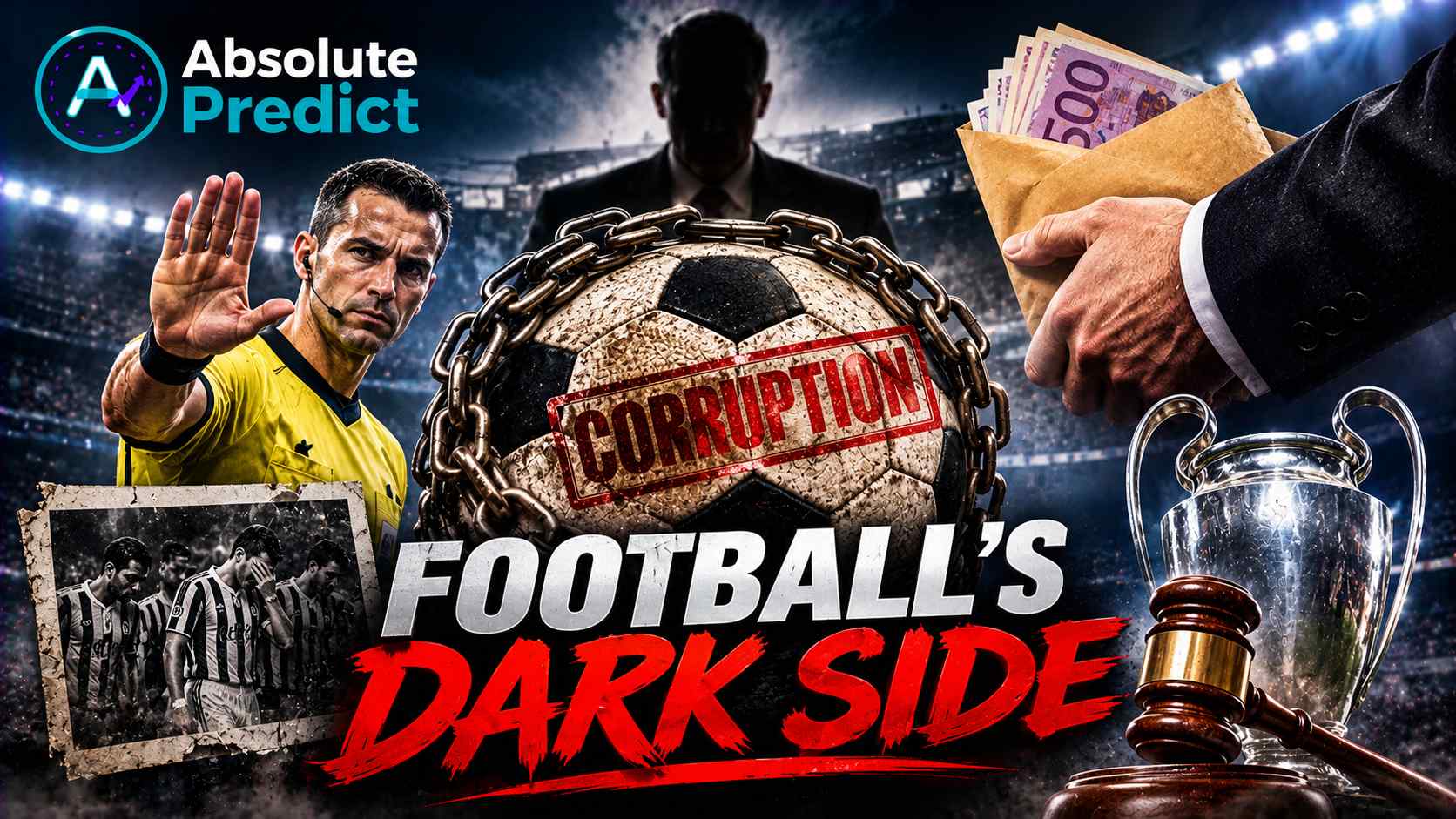
Football is built on moments of magic: a last-minute winner, a goalkeeper producing the impossible, or an underdog silencing a stadium packed with doubters. But the sport’s history also contains moments that left supporters questioning whether the contest they were watching had truly been fair.
From bribed players and manipulated referees to alleged criminal networks operating behind the scenes of international football, corruption has repeatedly threatened the credibility of the game. Some scandals resulted in convictions, titles being stripped and clubs suffering relegation. Others exposed serious allegations against powerful officials and institutions, with legal outcomes varying from case to case.
The most damaging scandals were not simply about money. They were about trust. Football supporters invest emotion, time and loyalty into a game whose central promise is that both teams have a fair chance to compete. When that promise is broken, the damage extends far beyond the scoreline.
Absolute Predict looks back at some of the most notorious corruption scandals in football history, examining what happened, how the cases unfolded and why their consequences continue to matter.
Editorial note: This is a selection of major documented scandals, not a definitive ranking. The article distinguishes established findings and convictions from allegations and disputed legal outcomes.
1. Calciopoli: The Italian Scandal That Changed Serie A (2006)
Few football scandals have shaken a major European league as deeply as Calciopoli.
In 2006, Italian football was engulfed by revelations surrounding communications between club officials and people involved in referee appointments. The scandal centred particularly on Juventus executive Luciano Moggi and allegations that the system of referee selection had been manipulated to favour certain clubs.
Juventus, AC Milan, Fiorentina and Lazio were among the clubs implicated in the disciplinary proceedings. The consequences were severe: Juventus were relegated to Serie B and stripped of their 2004–05 and 2005–06 Serie A titles. Other clubs faced points deductions.
The scandal also produced a complicated legal aftermath. Moggi and former Juventus executive Antonio Giraudo were convicted in a Naples court in 2011, but Italy’s highest court later ended the criminal case against them because the statute of limitations had expired. That procedural outcome should not be confused with a simple declaration that every allegation was disproved.
Calciopoli damaged the reputation of Italian football at a time when its clubs were among Europe’s most powerful. It also left a lasting question: how much confidence can supporters place in a competition when the integrity of its officiating system is under scrutiny?
2. Marseille’s Bribery Scandal: The 1993 European Champions in Disgrace
In May 1993, Olympique Marseille reached the summit of European football, defeating AC Milan 1–0 in the Champions League final. Basile Boli’s header secured the club’s place in history.
But the celebrations were soon overshadowed by a bribery scandal.
Days before the final, Marseille had defeated Valenciennes in a crucial French league match. Investigators uncovered evidence that Marseille figures had offered bribes to Valenciennes players in an attempt to influence the contest. One player, Jacques Glassmann, reported the approach, and money connected to the scheme was later discovered buried in a garden.
Marseille were stripped of their French league title, relegated and prevented from defending their European crown. Club president Bernard Tapie was convicted in connection with the affair and sentenced to prison.
The scandal created one of football’s most uncomfortable historical footnotes: Marseille had become European champions, but the domestic title-winning campaign that preceded the final was tainted by proven bribery.
The 1993 Champions League trophy itself was not taken away. That distinction remains important when discussing the case.
3. The FIFA Corruption Crisis: Football’s Governing Body Under Investigation (2015)
If club scandals threaten the credibility of individual competitions, corruption allegations involving football’s governing institutions threaten the entire sport.
In May 2015, the United States Department of Justice announced indictments against 14 individuals, including high-ranking football officials and sports marketing executives, in a case involving alleged racketeering, wire fraud and money laundering. The allegations centred on bribery and kickbacks connected to the commercial rights of football tournaments.
Further indictments followed in December 2015, with prosecutors alleging a long-running scheme involving more than $200 million in bribes and kickbacks. Several defendants pleaded guilty, while charges against others remained allegations subject to legal proceedings.
The crisis sent shockwaves through FIFA. It exposed how lucrative broadcasting and marketing rights could create opportunities for corruption when powerful officials operated with insufficient accountability.
The controversy was not simply about individual wrongdoing. It raised questions about governance, transparency and the systems responsible for safeguarding football’s global reputation.
4. Robert Hoyzer and the German Match-Fixing Scandal (2005)
A referee is supposed to be the neutral authority on the pitch. In Germany in 2005, Robert Hoyzer became the symbol of what happens when that trust is abused.
Hoyzer confessed to fixing football matches in return for payments linked to a betting syndicate. The scheme involved matches in Germany’s lower divisions and the German Cup. He was convicted of fraud and sentenced to two years and five months in prison.
The scandal also implicated other individuals, including betting syndicate figures. The case highlighted how lower-profile matches can be vulnerable to manipulation because they attract less public scrutiny and may involve participants with fewer financial resources.
It was a sobering reminder that football corruption does not always begin in executive offices or glamorous stadiums. Sometimes, it starts with a referee and a match that few outside the local football community are watching.
5. The 1980 Italian Totonero Scandal: When Betting Corruption Hit the National Game
Before Calciopoli, Italian football had already been rocked by a major betting scandal.
The Totonero affair emerged in 1980, involving an illegal betting network and allegations of match manipulation. Players and clubs were punished, with AC Milan and Lazio relegated. Italian striker Paolo Rossi was among those banned after being implicated in the scandal.
Rossi’s story became particularly striking. After serving his ban, he returned to the national team and played a central role in Italy’s 1982 World Cup triumph, finishing as the tournament’s top scorer.
The episode remains a powerful example of how football’s darkest controversies can become intertwined with its most celebrated sporting stories.
6. The 2011 K-League Match-Fixing Scandal: A League Under Siege
South Korea’s professional football league faced one of the most extensive match-fixing scandals in its history in 2011.
A later academic study examining the case reported that 21 matches across the 2010 and 2011 seasons were found to have been fixed. It also documented bans for 59 players across eight clubs, with additional people convicted of organising the schemes.
The scandal exposed links between match manipulation and illegal betting networks, including organised criminal groups. It also showed how players could be targeted or recruited into schemes designed to profit from predetermined outcomes.
The consequences extended beyond disciplinary action. The scandal damaged the league’s reputation and forced football authorities to confront the vulnerability of competitions to organised betting-related corruption.
7. The 2005 Genoa Scandal: Promotion Lost in a Bribery Case
Genoa appeared to have secured promotion to Serie A in 2005 after defeating Venezia 3–2 in the final match of the season.
The celebrations did not last.
The club was found guilty of bribing opponents in connection with the match. Genoa were relegated to the bottom of the Serie B standings, losing the promotion they had seemingly earned on the pitch.
It was a stark illustration of football’s sporting and disciplinary systems colliding. A result that looked like a breakthrough became a punishment that reshaped the club’s immediate future.
For supporters, the lesson was brutal: promotion is worth little if the route to it is found to have been corrupt.
8. The 2011 Turkish Football Scandal: Fenerbahçe and the Match-Fixing Investigation
Turkish football was thrown into turmoil in 2011 after an investigation into alleged match-fixing involving clubs, officials and players.
Fenerbahçe president Aziz Yıldırım was sentenced in the original proceedings for his role in alleged match-fixing involving several fixtures. The club was also excluded from the 2011–12 Champions League.
The case became highly contentious, with legal proceedings and later developments complicating the original narrative. It is therefore important not to present every allegation from the investigation as a settled fact.
Still, the affair left a lasting mark on Turkish football, highlighting the risks that arise when the integrity of league results becomes entangled with betting-related allegations and institutional conflict.
What These Scandals Have in Common
Across different countries and decades, several recurring patterns emerge.
- Financial incentives: Bribes, illegal betting profits, commercial rights and personal enrichment repeatedly appear in corruption cases.
- Abuse of authority: Referees, club executives, federation officials and players have sometimes used positions of trust to influence outcomes or systems.
- Weak oversight: Manipulation becomes easier when transparency and accountability are inadequate.
- Damage to supporters’ trust: Fans can accept defeat. Discovering that a contest may have been manipulated is a different kind of betrayal.
- Long-lasting consequences: Relegations, title removals, bans, criminal convictions and reputational damage can follow a scandal for years.
Football corruption is not one single problem. Match-fixing, bribery, governance corruption and financial misconduct are different forms of wrongdoing. They should be examined carefully rather than grouped together as though every case involved the same conduct.
Can Football Ever Eliminate Corruption?
Completely eliminating corruption may be difficult, but football can reduce its risks through stronger oversight and transparent decision-making.
That means independent investigations, clear rules for referee appointments, financial accountability, protection for whistleblowers and serious consequences for proven misconduct. Betting-related monitoring can also help identify suspicious patterns, although unusual odds movements alone are not proof that a match has been fixed.
Football authorities must also distinguish between allegations and established wrongdoing. A credible investigation should follow evidence, not public pressure or club rivalries.
The sport’s integrity depends not only on punishing those who break the rules, but also on building systems that make corruption harder to conceal.
Absolute Predict Verdict: Football’s Greatest Betrayal Is the Loss of Trust
Football has survived controversial refereeing decisions, bitter rivalries and results that supporters still argue about decades later. Those are part of the game’s emotional fabric.
Corruption is different.
When a match is manipulated, a referee compromised or a governing official bribed, the damage reaches the heart of football. The contest stops being a fair sporting test and becomes something supporters never agreed to watch.
Calciopoli exposed the vulnerability of a major league’s referee-selection system. Marseille’s bribery scandal showed that even a European champion could be punished for domestic misconduct. The FIFA crisis revealed how corruption allegations could reach the highest levels of football governance. Hoyzer’s case demonstrated that a single compromised referee could undermine confidence in an entire competition.
For Absolute Predict readers, these episodes also underline why football analysis must be built on credible information. Understanding the game means more than examining formations, statistics or likely scorelines. It means recognising the institutions and integrity that allow the sport to be meaningful in the first place.
Football’s most important result is not always the one on the scoreboard. Sometimes, it is whether the game can still be trusted.
Share this insight
Leave a Comment
Comments are turned off for now
Keep reading
Related articles
Harry Kane’s Ballon d’Or Triumph Meets an Unexpected Snub
Harry Kane has been omitted from the 2026 FIFPRO World 11 despite winning the Ballon d’Or. Explore t…
Cristiano Ronaldo Retires from Portugal: A Legendary No. 7 Bids Farewell to the National Team
Cristiano Ronaldo retires from Portugal after 234 caps and 146 goals. Explore his trophies, internat…

Jesús de Miguel Dies at 30 After Tragic On-Pitch Collision: Spanish Football in Mourning
CD Tenerife forward Jesús de Miguel has died aged 30 after a collision with Andorra goalkeeper Jesús…

Cristiano Ronaldo’s 2008 Ballon d’Or Voted the Greatest of All Time: The Season That Changed Everything
Cristiano Ronaldo’s 2008 Ballon d’Or-winning season beats Messi’s 2012 campaign in a special fan vot…
Sam Dick
Published Nov 8, 2026
Focus Keyword
Description
Explore the most corrupt moments in football history, from Calciopoli and Marseille’s bribery scandal to FIFA corruption and infamous match-fixing cases.
Category
No comments yet. Be the first to comment!