Absolute Predict · Blog
How Premier league tables work & points system football
Learn how Premier League and other football league tables work, including points, goal difference, European places, promotion and relegation.
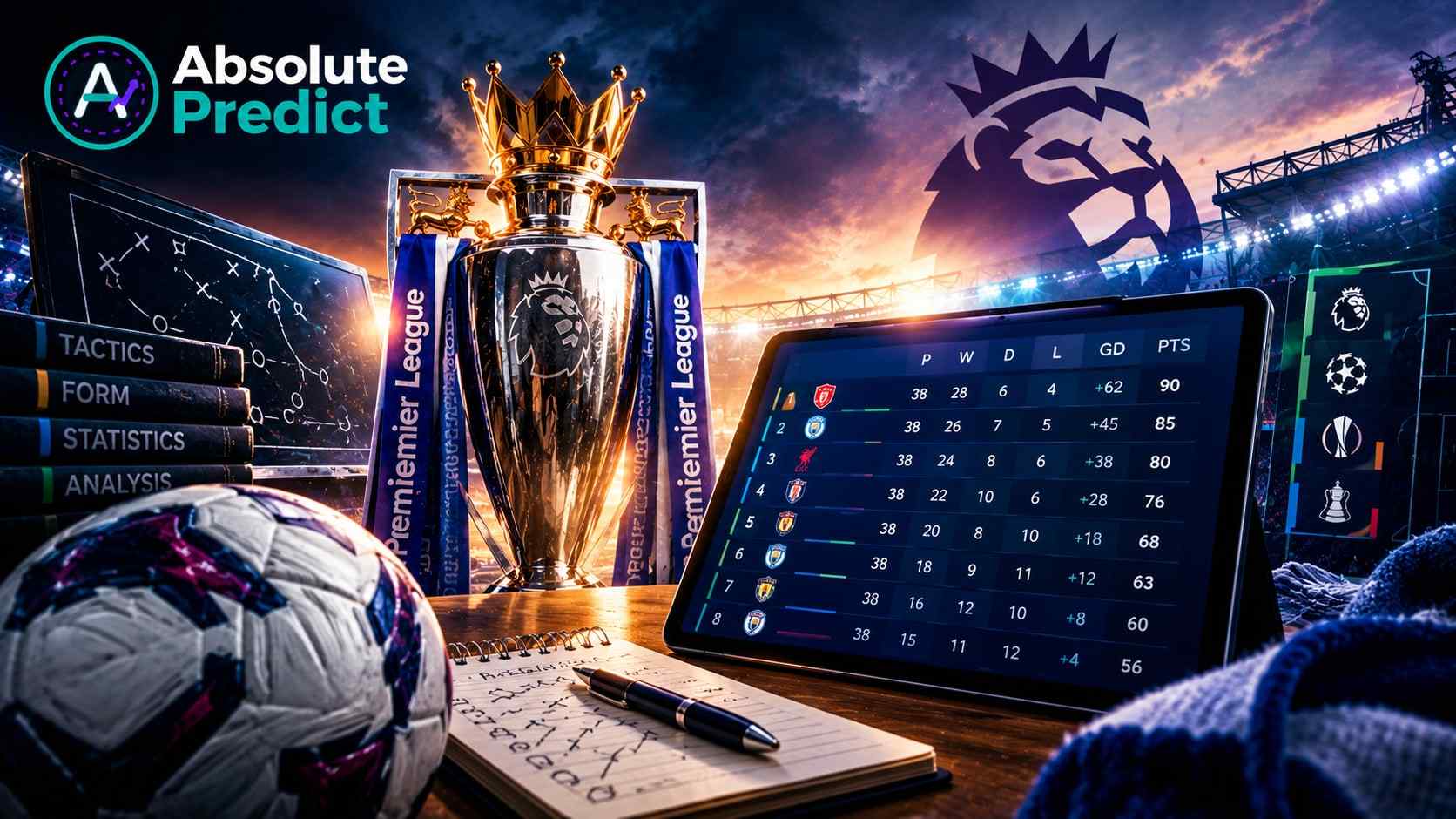
A football league table looks simple until you actually try to explain it.
There are 20 teams. Numbers sit beside their names. Some clubs are chasing the title, others are fighting for Europe, and a few are desperately trying to stay above the dreaded bottom three.
But what do all those columns mean? Why can a team with the same points sit below another? Why does finishing fourth matter so much? And does every major league use exactly the same system?
Not quite.
The basic idea is shared across much of European football, but the details can change considerably from one competition to another. Here's the part that makes the table finally make sense.
The Football League Table Is Really a Running Scoreboard
At its heart, a league table answers one question:
How well has each team performed across the season?
In the Premier League, every club plays 38 league matches, once at home and once away against each of the other 19 clubs. That produces 380 matches across the 20-team competition.
The scoring system is deliberately straightforward:
- Win = 3 points
- Draw = 1 point
- Loss = 0 points
So if Arsenal beat Chelsea 2-1, Arsenal receive three points while Chelsea receive none.
If they draw 1-1, both receive one point.
And if Chelsea win, the three points travel in the opposite direction.
It sounds obvious, but this is the engine underneath the entire table.
What Do PL, W, D, L, GF, GA and GD Actually Mean?
This is where the table starts looking like it was designed by someone who enjoys abbreviations.
Here is the translation:
| ColumnMeaning | |
| Pos | Position in the league |
| Pl | Matches played |
| W | Wins |
| D | Draws |
| L | Losses |
| GF | Goals scored |
| GA | Goals conceded |
| GD | Goal difference |
| Pts | Points |
The most important numbers are usually Pts and GD.
Goal Difference: The Number That Can Change Everything
Goal difference is simply:
Goals scored − goals conceded
Imagine a team has scored 60 goals and conceded 40.
Its goal difference is:
60 − 40 = +20
Another team might also have 60 points but a +12 goal difference.
If the two teams finish level on points in the Premier League, the team with the better goal difference ranks higher. Goals scored is the next tiebreaker.
That is why a 5-0 victory isn't merely good for morale. Those extra goals can become valuable mathematical ammunition months later.
Why Does the Table Change After Every Match?
Because the table is not a ranking based on reputation.
Manchester United can lose to a newly promoted club and receive zero points. The promoted club gets three.
The league doesn't care who has the bigger stadium, the bigger wage bill or the more famous badge.
That is one reason league football is so different from a knockout tournament.
A club can have one terrible afternoon and still have 37 more matches to repair the damage.
What Happens When Teams Have the Same Points?
This is where things get interesting.
In the Premier League, the current order of tiebreakers is:
- Points
- Goal difference
- Goals scored
- Head-to-head points
- Head-to-head away goals
If teams competing for the title, European qualification or survival still cannot be separated, a one-off play-off at a neutral venue can theoretically be used. It has never actually been required in Premier League history.
So when you see two teams level on 50 points, don't automatically assume the one with fewer points doesn't exist. Look across the other columns.
The table has more memory than the points column alone suggests.
What Do the Top and Bottom of the Table Mean?
The table is effectively divided into several battles.
First Place: The Champion
After all 38 matches, the club with the most points wins the Premier League.
There is no separate championship final.
The table itself decides the champion.
European Places
The clubs near the top can also qualify for UEFA competitions.
Exactly which positions receive Champions League, Europa League or Conference League places can vary from season to season because UEFA access rules and domestic cup results can affect the allocation. The 2025/26 Premier League season, for example, included an additional Champions League place through England's European Performance Spot.
So it is better to think of European qualification as a moving target, rather than assuming that fourth, fifth or sixth always means exactly the same thing every season.
The Bottom Three
This part is much less glamorous.
Teams finishing 18th, 19th and 20th are relegated to the Championship. They are replaced by three promoted Championship clubs: the top two automatically, plus the winner of the Championship play-offs.
And suddenly a team sitting 17th with four matches remaining can feel like it has just won a trophy.
Football has a funny way of changing the meaning of "success."
But Do All Football Leagues Work Like the Premier League?
No, and this is where many new football fans get caught out.
The three-points-for-a-win system is widespread, but the number of clubs, matches, promotion rules and relegation arrangements can differ.
Bundesliga: A Smaller Top Division
Germany's Bundesliga has 18 clubs, not 20.
Each team plays 34 matches, home and away against every other club.
Germany also has an interesting promotion and relegation twist.
The bottom two Bundesliga clubs are automatically relegated, while the team finishing 16th enters a two-legged play-off against the third-placed club from the second tier.
So 16th place in Germany isn't simply "safe" or "down."
It can mean one more high-pressure tie before the club knows its fate.
Serie A: 20 Teams, 38 Matches
Italy's Serie A follows the familiar 20-team, 38-match structure.
The official 2026/27 schedule again contains 20 clubs and 380 matches across 38 matchdays.
Like the Premier League, the table is central to deciding the champion, European qualification and relegation positions.
But individual competitions can have their own tiebreaking details, so football fans shouldn't assume that every league uses an identical rulebook simply because the table looks familiar.
LaLiga: Similar Shape, Different Details
Spain's top flight also operates with 20 teams playing 38 matches.
At the bottom, the three lowest-ranked clubs are relegated. The 2025/26 season again saw three teams drop into the second tier, while promotion from the second tier involved automatic promotion plus a play-off route.
So the broad European model is easy to recognise:
Play matches → collect points → climb the table → qualify, win, survive or go down.
The interesting part is what happens around the edges.
Why the League Table Matters for Football Predictions
For anyone following football predictions, the table is more than a decorative graphic.
It provides context.
A team sitting third might be chasing the title.
A team sitting 16th could be fighting relegation.
A club in eighth might have little to play for domestically, or could still be chasing European football.
That context can influence how a match should be analysed.
This is where Absolute Predict can be useful as a research companion. Instead of looking at a team's position and immediately declaring it the better side, readers can combine league position with recent form, home-and-away performance, goals scored, goals conceded, injuries, fixtures and the specific betting market being considered.
A league position tells you where a team is.
It doesn't necessarily tell you why it is there.
And that distinction matters.
The Table Can Lie — At Least Temporarily
A league table is factual, but interpreting it requires more care.
Suppose Team A has 30 points from 15 matches and Team B has 25 from 15.
Team A is higher.
Simple.
But what if Team A has played 10 of those matches against teams currently in the bottom half, while Team B has faced most of the league's strongest sides?
The table doesn't explain that by itself.
Likewise, two teams can have identical points while arriving there through completely different football.
One might win 1-0 every week.
Another might score freely but concede almost as often.
Same points. Very different stories.
That is why serious football analysis goes beyond the table.
Share this insight
Leave a Comment
Comments are turned off for now
Keep reading
Related articles
The Premier League: How England’s Top Football League Works
Learn how the Premier League works, including its 20-team format, points system, league table, Europ…

Manchester City’s 115-Charge Case: 114 Guilty Verdicts Reported, But the Biggest Chapter Is Still to Come
Manchester City have reportedly been found guilty of 114 of 115 Premier League financial charges. He…

Top 10 Richest Football Coaches in the World in 2026
Discover the top 10 richest football coaches in 2026, including Mourinho, Guardiola, Simeone, Zidane…

Top 10 Richest Footballers in the World in 2026
Discover the top 10 richest footballers in the world in 2026, including Cristiano Ronaldo, Lionel Me…
Sam Dick
Published Sep 28, 2026
Focus Keyword
Description
Learn how Premier League and other football league tables work, including points, goal difference, European places, promotion and relegation.
Category
No comments yet. Be the first to comment!