Absolute Predict · Blog
NBA Players with the Most Championships: All-Time List
Discover the NBA players with the most championships, from Bill Russell's record 11 rings to Michael Jordan, Kareem, LeBron James and Kobe Bryant.
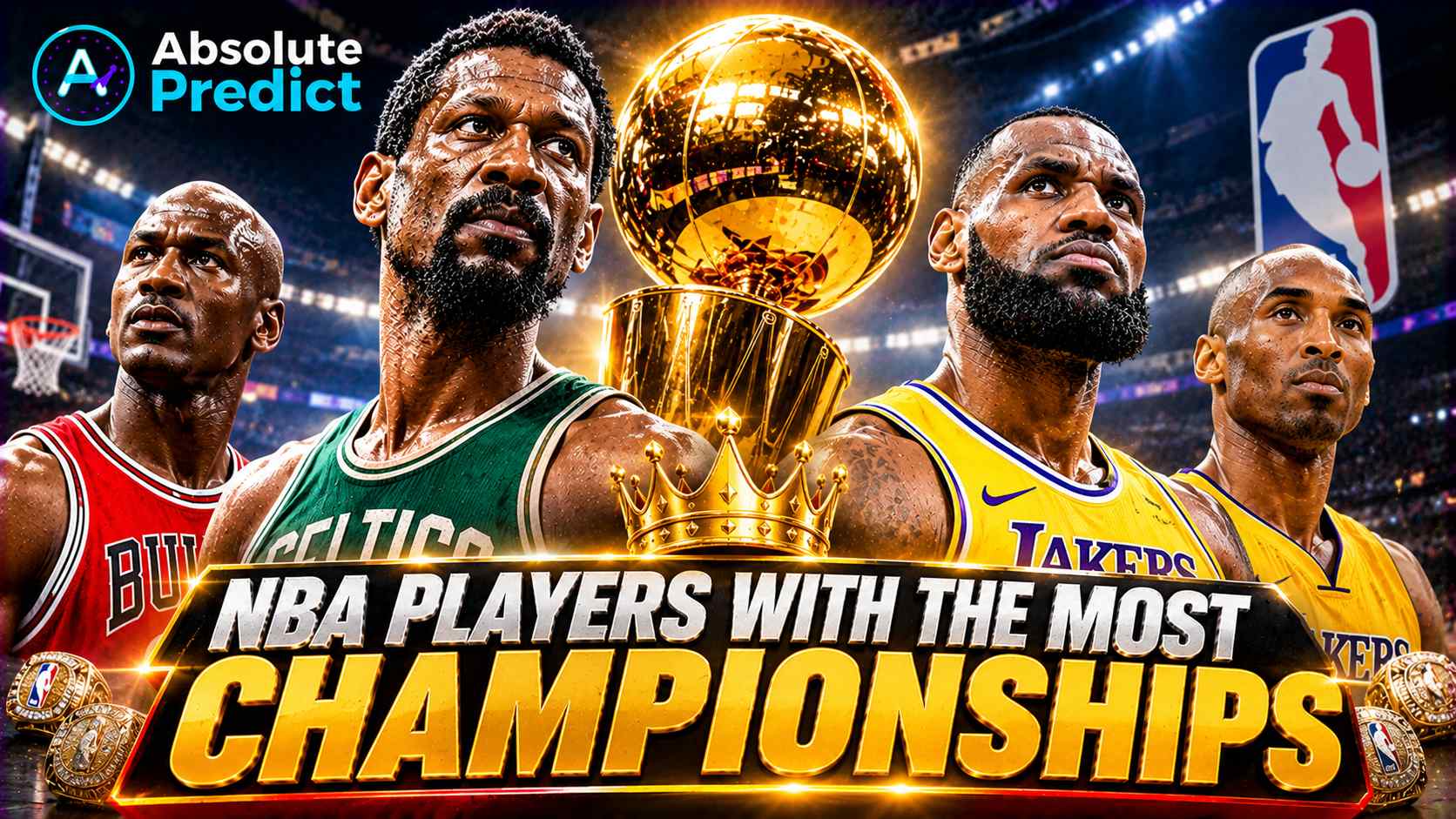
Winning an NBA championship once can define a career. Winning it twice puts a player in distinguished company. Winning five, six or even more places them in a category where the conversation is no longer just about talent — it is about sustained excellence, extraordinary teams and an ability to deliver when the stakes are highest.
The NBA has produced some remarkable winners, from the Boston Celtics dynasty of the 1950s and 1960s to the Chicago Bulls of the Michael Jordan era and the modern champions who have built their own legacies. Yet when it comes to the players with the most championship rings, the leaderboard has a familiar name at the top: Bill Russell.
His record of 11 NBA championships remains one of the most extraordinary achievements in professional sport. But who comes next? How many rings did Michael Jordan, LeBron James, Kobe Bryant and other icons collect? And does winning more championships automatically make someone the greatest player in NBA history?
Let's examine the numbers, the dynasties and the stories behind basketball's most decorated champions.
NBA Players with the Most Championships: The All-Time Ranking
The following ranking counts NBA championships won as a player. It does not combine playing titles with championships earned later as a coach or executive.
1. Bill Russell – 11 NBA Championships
Teams: Boston Celtics
Championship years: 1957, 1959–1966, 1968, 1969
Bill Russell stands alone at the top of the NBA's championship leaderboard.
During his 13-season playing career, Russell won 11 championships with the Boston Celtics. That means he collected a title in almost every season he played, a level of sustained success that remains difficult to comprehend.
Russell's contribution was not simply about scoring points. He was an exceptional rebounder, an influential defensive centre and the foundation of Boston's championship identity.
He averaged 22.5 rebounds per game during his NBA career and won five regular-season MVP awards.
His Celtics teams also achieved something extraordinary: eight consecutive championships from 1959 through 1966.
Russell's legacy is a reminder that basketball greatness cannot be measured by scoring alone. His ability to protect the basket, control rebounds, organise the defence and make teammates better helped create one of the greatest dynasties in professional sport.
The record of 11 championship rings remains untouched.
2. Sam Jones – 10 NBA Championships
Team: Boston Celtics
Sam Jones is second on the all-time list with 10 NBA championships, all won alongside Bill Russell in Boston.
Often nicknamed "Mr. Clutch", Jones was one of the most dependable scorers of the Celtics dynasty. He was particularly respected for his shooting ability and his composure in important moments.
Jones played all 12 NBA seasons with Boston, averaging 17.7 points per game during the regular season. His playoff scoring average rose to 18.9 points, underlining his ability to perform when the pressure increased.
His championship collection includes every Celtics title from 1959 through 1966, followed by the championships in 1968 and 1969.
Jones was not simply a passenger on a winning team. He was a major offensive contributor who helped turn Russell's defensive dominance into championship success.
3. John Havlicek – 8 NBA Championships
Team: Boston Celtics
John Havlicek was one of the most versatile players of his generation.
He won eight NBA championships with Boston, spanning the Russell era and the Celtics' later title successes in 1974 and 1976.
Havlicek could score, defend, run the floor and contribute in several positions. His endurance was legendary, and his ability to maintain a high level of performance made him a central figure in Boston's continued success.
He also became one of the franchise's most productive scorers, finishing his career with 26,395 regular-season points.
His famous steal against the Philadelphia 76ers in the 1965 Eastern Division Finals remains one of the most celebrated defensive plays in NBA history.
Havlicek's career illustrates how championship teams need more than one superstar. They need players capable of adapting, making important contributions and delivering across different eras.
4. Tom Heinsohn – 8 NBA Championships
Team: Boston Celtics
Tom Heinsohn was another key member of Boston's dominant 1950s and 1960s teams.
He won eight championships as a player, all with the Celtics, and was named NBA Rookie of the Year in 1957.
Heinsohn was a productive forward who could score and rebound effectively. He averaged 18.6 points per game during his playing career and was selected for six NBA All-Star Games.
His basketball legacy did not end when he stopped playing.
Heinsohn later coached the Celtics to two additional NBA championships in 1974 and 1976. Those coaching titles are separate from his eight playing championships, although they make his overall contribution to Boston's history even more remarkable.
5. K.C. Jones – 8 NBA Championships
Team: Boston Celtics
K.C. Jones was one of the most accomplished defensive guards of the Celtics dynasty.
He won eight NBA championships as a player, all with Boston, and became known for his defensive discipline, intelligent decision-making and ability to contribute without demanding the spotlight.
Jones was not the leading scorer on those Celtics teams, but that was never the only measure of his value.
He helped control opposing guards, protect possession and keep Boston's system functioning.
Like Heinsohn, Jones later enjoyed success as a coach. He guided the Celtics to two further NBA championships in 1984 and 1986.
His playing record and coaching achievements make him one of the most successful figures in franchise history.
6. Tom Sanders – 8 NBA Championships
Team: Boston Celtics
Tom Sanders is another member of the remarkable group of Celtics players with eight championship rings.
He played his entire NBA career in Boston and was an important defensive presence during the franchise's dominant period.
Sanders was particularly valued for his defensive work, rebounding and willingness to perform the less glamorous responsibilities that championship teams depend on.
His eight titles came between 1961 and 1969.
He may not be as widely recognised by casual fans as Russell or Havlicek, but his championship record places him among the most successful players the NBA has ever produced.
7. Robert Horry – 7 NBA Championships
Teams: Houston Rockets, Los Angeles Lakers, San Antonio Spurs
Robert Horry deserves special attention because his seven championships were won with three different franchises.
He won two titles with the Houston Rockets in 1994 and 1995, three with the Los Angeles Lakers in 2000, 2001 and 2002, and two with the San Antonio Spurs in 2005 and 2007.
Unlike the Celtics legends above him, Horry did not spend his career with one dominant team.
He became one of the most valuable role players in championship basketball, earning a reputation for making important shots in high-pressure situations.
His nickname, "Big Shot Rob", was well earned.
Horry's career demonstrates how important supporting players can be. Championship teams need stars, but they also need players who understand their roles and can deliver when the game is tight.
8. Jim Loscutoff – 7 NBA Championships
Team: Boston Celtics
Jim Loscutoff won seven championships with the Boston Celtics between 1957 and 1964.
He was a physical forward who contributed through rebounding, defence and toughness.
Loscutoff was not expected to dominate the scoring statistics. His role was to provide energy, defend opponents and help maintain the competitive edge that made Boston so difficult to beat.
He was part of the Celtics' early championship success and remains one of the most decorated players in NBA history.
His name may not generate the same recognition as Russell's, but seven championship rings tell their own story.
9. Frank Ramsey – 7 NBA Championships
Team: Boston Celtics
Frank Ramsey also collected seven NBA championships during his time with Boston.
He played as a forward and became an important scoring option for the Celtics, particularly as the team's dynasty developed.
Ramsey was one of the early examples of a highly effective sixth man — a player who could come off the bench and make a significant contribution without necessarily starting every game.
His ability to score, attack mismatches and provide offensive energy made him valuable to Boston's championship system.
He was part of seven title-winning teams between 1957 and 1964.
10. Bob Cousy, Kareem Abdul-Jabbar, Michael Jordan and Scottie Pippen – 6 NBA Championships Each
The six-championship group contains several players whose careers shaped very different periods of NBA history.
Bob Cousy
Team: Boston Celtics
Bob Cousy won six championships with Boston between 1957 and 1963.
He was one of the league's most influential early point guards, known for his passing, ball-handling and ability to control the offence.
Cousy won the NBA MVP award in 1957 and was selected as an All-Star 13 times.
His creativity helped establish the point guard as a central playmaking position in modern basketball.
Kareem Abdul-Jabbar
Teams: Milwaukee Bucks, Los Angeles Lakers
Kareem Abdul-Jabbar won six NBA championships: one with the Milwaukee Bucks in 1971 and five with the Los Angeles Lakers in 1980, 1982, 1985, 1987 and 1988.
He was one of the most dominant players in basketball history, combining extraordinary longevity with an almost unstoppable signature move: the skyhook.
Kareem also won six regular-season MVP awards, the most in NBA history.
His championship success across two franchises demonstrates his ability to remain elite through different stages of his career.
Michael Jordan
Team: Chicago Bulls
Michael Jordan won six NBA championships, all with the Chicago Bulls.
His titles came in two historic three-peats:
- 1991, 1992 and 1993.
- 1996, 1997 and 1998.
Jordan was named NBA Finals MVP on all six occasions.
His championship record is particularly impressive because Chicago never lost an NBA Finals series during his career.
Jordan's scoring ability, competitiveness and performances in decisive moments helped turn the Bulls into one of the most recognisable sporting dynasties in history.
His six titles remain central to the debate about the greatest basketball player of all time.
Scottie Pippen
Team: Chicago Bulls
Scottie Pippen also won six championships with the Chicago Bulls, playing alongside Jordan during both three-peat periods.
Pippen was one of the most versatile forwards in NBA history. He could defend several positions, create opportunities for teammates, handle the ball and contribute as a scorer.
His importance to the Bulls should never be reduced to being Jordan's teammate.
He was a major part of the team's tactical identity and one of the best two-way players of his generation.
What About LeBron James, Kobe Bryant and Stephen Curry?
The all-time leaderboard is dominated by players from earlier eras, but several modern superstars have built impressive championship records of their own.
| Player / NBA championships / Championship teams | ||
| LeBron James | 4 | Miami Heat, Cleveland Cavaliers, Los Angeles Lakers |
| Kobe Bryant | 5 | Los Angeles Lakers |
| Stephen Curry | 4 | Golden State Warriors |
| Shaquille O'Neal | 4 | Los Angeles Lakers, Miami Heat |
| Tim Duncan | 5 | San Antonio Spurs |
| Magic Johnson | 5 | Los Angeles Lakers |
| Larry Bird | 3 | Boston Celtics |
| Kevin Durant | 2 | Golden State Warriors |
| Dwyane Wade | 3 | Miami Heat |
These figures show that championship success has taken different forms across generations.
Kobe Bryant and Tim Duncan each won five titles, while Shaquille O'Neal collected four. LeBron James has won championships with three different franchises, an achievement that distinguishes his career.
Stephen Curry's four titles helped establish Golden State as one of the defining teams of the modern NBA era.
The fact that these players have fewer rings than Russell does not diminish their achievements. The NBA has become increasingly competitive, with different playoff formats, larger talent pools and changing team-building strategies.
Which NBA Player Has Won Championships with the Most Teams?
Robert Horry, John Salley, LeBron James and Danny Green are among the players who have won NBA championships with three different franchises.
Their achievements highlight a different kind of championship success.
Some players build a dynasty with one organisation, while others contribute to winning teams across different environments.
LeBron James is particularly notable because he won Finals MVP awards with all three franchises where he secured championships: Miami, Cleveland and the Los Angeles Lakers.
That is an unusual achievement in NBA history.
Does Having the Most NBA Rings Make Someone the Greatest Player?
This is where the discussion becomes more interesting.
Championship rings are an important part of a player's legacy, but they cannot tell the entire story.
Bill Russell won 11 championships, but he played for one of the most dominant teams in NBA history. His success was built on a remarkable combination of defensive excellence, leadership and a strong supporting cast.
Michael Jordan won six titles and was Finals MVP on every occasion. His championship record is often used as evidence of his extraordinary individual impact.
LeBron James has won four titles with three different teams, demonstrating a different kind of longevity and adaptability.
Meanwhile, players such as Allen Iverson, Charles Barkley and Karl Malone never won an NBA championship despite having outstanding individual careers.
A championship is a team achievement. It requires talent, coaching, health, chemistry, organisation and often a little fortune.
The best way to judge a player's greatness is to consider the full picture: individual performance, influence on winning, longevity, awards, leadership and postseason impact.
Rings matter. They just should not be the only thing that matters.
Why the Boston Celtics Dominate the Championship Records
One detail stands out when examining the all-time list: the Boston Celtics appear repeatedly near the top.
The franchise won 11 championships between 1957 and 1969, including eight consecutive titles from 1959 to 1966.
Bill Russell was the central figure, but the team's success depended on a remarkable collection of talent.
Sam Jones supplied scoring and clutch shooting. Bob Cousy orchestrated the offence. John Havlicek offered versatility and endurance. Tom Heinsohn, K.C. Jones, Tom Sanders and others played important roles.
The Celtics also benefited from excellent coaching and a strong organisational structure under Red Auerbach.
Their dynasty was not built around one player doing everything. It was a system in which different players contributed to a common objective.
That is why so many Boston players remain high on the all-time championship list.
Final Thoughts: Championship Rings Tell a Story, Not the Whole Story
The NBA's most decorated champions represent different eras, playing styles and approaches to winning.
Bill Russell's 11 championships remain the standard. Sam Jones follows with 10, while four Celtics legends share eight titles. Robert Horry stands out with seven championships earned across three franchises, and the six-ring group includes Kareem Abdul-Jabbar, Michael Jordan and Scottie Pippen.
Modern greats such as LeBron James, Kobe Bryant, Stephen Curry and Tim Duncan have also built championship records that deserve their place in basketball history.
For anyone following the NBA, these numbers offer more than a leaderboard. They reveal how dynasties are built, how supporting players shape success and why sustained winning is one of the hardest achievements in professional sport.
At Absolute Predict, understanding basketball means looking beyond individual points and highlight plays. Team structure, player roles, consistency and the ability to perform under postseason pressure all help explain why some teams keep winning when others fall short.
The ring count is a useful starting point. The story behind each ring is what makes the history worth exploring.
Share this insight
Leave a Comment
Comments are turned off for now
Keep reading
Related articles
NBA vs FIBA: 12 Major Differences Every Basketball Fan Should Understand
Discover the major differences between NBA and FIBA basketball, including court size, game time, fou…
Victor Wembanyama Stats, Records and Career Highlights: The Rise of Basketball's Most Unusual Superstar
Explore Victor Wembanyama's NBA career stats, records, awards and highlights, including his Defensiv…
Nikola Jokić and Jamal Murray Make NBA History: Denver's Dynamic Duo Rewrite the Record Books
Explore Victor Wembanyama's NBA career stats, records, awards and highlights, including his Defensiv…

Weekend Basketball Betting: How to Analyse Games and Make Smarter Predictions
Learn how to analyse weekend basketball games using team form, injuries, point spreads, totals and p…
Sam Dick
Published Nov 24, 2026
Focus Keyword
Description
Discover the NBA players with the most championships, from Bill Russell's record 11 rings to Michael Jordan, Kareem, LeBron James and Kobe Bryant.
Category
No comments yet. Be the first to comment!