Absolute Predict · Blog
NBA vs FIBA: 12 Key Differences in Basketball Rules
Discover the major differences between NBA and FIBA basketball, including court size, game time, fouls, three-point distance, timeouts and defensive rules.
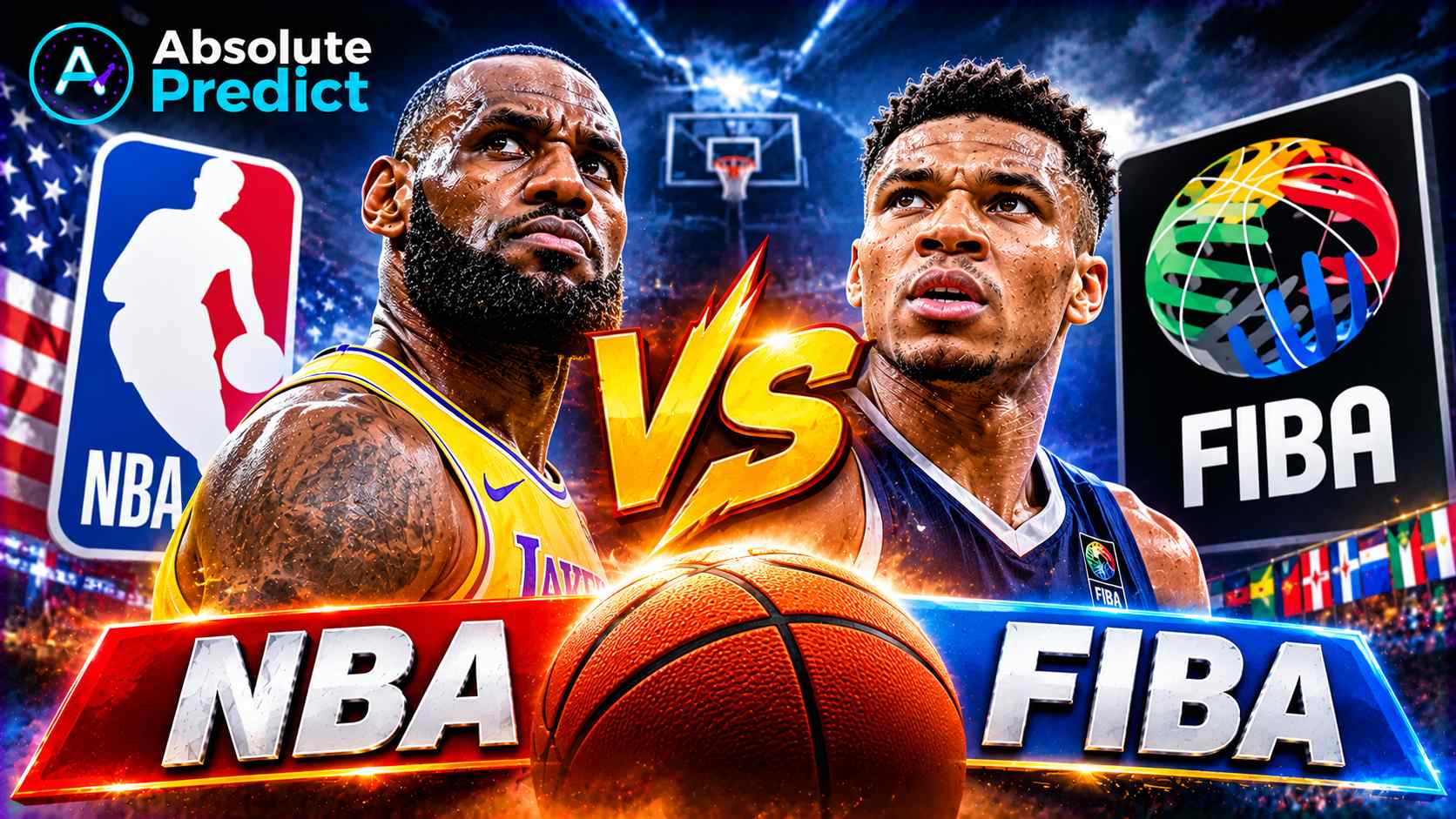
Basketball may look like the same sport wherever it is played, but switch on an NBA game and then watch a FIBA international contest, and some familiar rules suddenly behave rather differently.
The court is smaller in the NBA. The three-point line sits farther away. Defensive players have different freedoms, game clocks run differently, and even the way a team manages its final seconds can change depending on which rulebook is in charge.
These differences are not cosmetic details reserved for referees and coaching staff. They influence tactics, player statistics, scoring opportunities and the rhythm of a game. A player who dominates under one system may need to adjust certain habits when competing under the other.
So, what exactly separates NBA basketball from FIBA basketball? Here is a practical breakdown of the most important differences, why they exist and how they affect what happens on the court.
What Do NBA and FIBA Mean?
Before comparing the rules, it is important to understand what the two organisations represent.
NBA stands for the National Basketball Association. It is the major professional basketball league in the United States and Canada, featuring some of the most recognisable players and teams in the sport.
FIBA stands for the International Basketball Federation. It is the international governing body responsible for basketball's global rules and competitions, including the FIBA Basketball World Cup and Olympic basketball tournaments.
The NBA operates under its own playing rules, while international competitions organised under FIBA follow the FIBA Official Basketball Rules.
The distinction matters because the NBA is a professional league, whereas FIBA provides the framework for international basketball competitions and many national leagues around the world.
Both play the same sport. They simply do not administer every detail in exactly the same way.
NBA vs FIBA: Quick Comparison
1. Game Duration: NBA Games Last Longer
One of the clearest differences between NBA and FIBA basketball is the length of the game.
An NBA game consists of four 12-minute quarters, giving a total of 48 minutes of regulation playing time.
FIBA games consist of four 10-minute quarters, giving a total of 40 minutes.
That means an NBA contest has eight additional minutes of regulation basketball.
It may not sound like a dramatic difference, but eight minutes can change a great deal. NBA players have more time to accumulate points, rebounds and assists, while coaches have a longer period to manage rotations and make tactical adjustments.
It also means that comparing players' raw statistics across the two systems requires some care. A player scoring 30 points in an NBA game has had a longer regulation period to produce those numbers than someone scoring 30 in a standard FIBA contest.
Both systems use five-minute overtime periods when a game is tied after regulation.
2. Court Dimensions: The NBA Court Is Slightly Bigger
The NBA uses a court measuring 94 feet long and 50 feet wide.
FIBA courts measure 28 metres long and 15 metres wide. Converted into feet, that is approximately 91.9 feet by 49.2 feet.
The difference is relatively small, but it can influence spacing, movement and defensive positioning.
A larger playing area gives NBA teams slightly more room to spread the floor, create driving lanes and move the ball around the perimeter.
FIBA's slightly smaller court can make the playing area feel more congested, particularly when teams use aggressive defensive pressure or pack players around the basket.
However, court size alone does not explain why NBA and international games can look different. Rules governing defence, contact and offensive movement also contribute.
3. Three-Point Line: NBA Shooters Have a Longer Distance
The three-point shot is one of basketball's most exciting weapons, and the distance from which it is taken differs between the NBA and FIBA.
In the NBA, the three-point line is 23 feet 9 inches from the basket at the top of the arc. It moves closer to 22 feet in the corners.
In FIBA basketball, the three-point arc is 6.75 metres from the basket, with the corner distance slightly shorter.
In practical terms, the NBA three-point line is farther away, particularly around the top of the arc.
This difference can affect shooting percentages and offensive strategy.
A player who is comfortable shooting from the FIBA three-point line may need to adjust to the longer NBA distance. Conversely, NBA shooters who regularly attempt shots from well beyond the arc may find the FIBA line more inviting.
It is one reason why a player's three-point statistics should not always be compared without considering the competition in which they were recorded.
4. Defensive Three-Second Rule: A Major Tactical Difference
This is arguably one of the most important differences between the two systems.
The NBA has a defensive three-second rule. A defender cannot remain in the restricted area near the basket for more than three seconds unless they are actively guarding an opponent.
In simple terms, a defender cannot simply stand underneath the basket for an extended period waiting to block every attempt.
The rule encourages defensive movement and creates more opportunities for attackers to drive towards the rim.
FIBA basketball does not have the same defensive three-second restriction.
A FIBA defender can remain in the paint without having to actively guard an opponent within the NBA's three-second framework, although other defensive rules still apply.
This gives teams more freedom to use traditional interior defenders and protect the basket through positioning.
It also helps explain why some international teams can employ compact defensive systems that look different from the defensive schemes commonly seen in the NBA.
Importantly, both systems have an offensive three-second rule. An attacking player cannot simply camp inside the opponent's restricted area indefinitely while their team controls the ball.
5. Personal Fouls: NBA Players Get One More
Another significant difference concerns how many personal fouls a player can commit before being disqualified from the game.
In the NBA, a player is disqualified after committing six personal fouls.
Under FIBA rules, a player must leave the game after committing five fouls.
This means FIBA players have less room for error.
Imagine a centre who is responsible for protecting the basket. If that player collects four fouls early in a FIBA game, the coach must be careful about keeping them on the court. One more personal foul means they are finished for the game.
In the NBA, that same player would still have two personal fouls available before reaching the six-foul limit.
The difference can influence defensive aggression, substitution patterns and how coaches manage their most important players.
6. Team Fouls and the Bonus System
The way team fouls are counted also affects how quickly opponents receive free throws.
In FIBA basketball, a team enters the penalty situation after committing four team fouls in a quarter. Subsequent qualifying defensive personal fouls on players who are not shooting generally result in two free throws.
The NBA also operates a team-foul penalty system, but its details differ. Generally, a team enters the penalty after its fourth team foul in a quarter, meaning qualifying fouls from the fifth team foul onward lead to free throws. Special provisions apply in the final two minutes of a quarter.
The practical point is that repeated fouling becomes increasingly expensive.
A team that loses its defensive discipline can give away easy points without the opposition having to score from open play.
For coaches, managing foul trouble is therefore about more than keeping individual players available. It also means preventing the entire team from putting opponents on the free-throw line.
7. Timeouts: NBA Coaches Have More Opportunities
Timeouts allow coaches to stop play, organise their teams, change tactics and give players a short break.
However, NBA and FIBA competitions distribute these opportunities differently.
In the NBA, each team receives seven charged timeouts during regulation. There are also restrictions on how many can be used in the fourth quarter and during its closing minutes.
Under standard FIBA rules, each team receives:
- Two timeouts in the first half.
- Three timeouts in the second half, with no more than two allowed in the final two minutes of the fourth quarter.
- One timeout in each overtime period.
Unused FIBA timeouts cannot be carried into the next half or overtime.
The difference affects coaching decisions, particularly during close games.
NBA coaches have a larger overall timeout allowance, but they must still manage restrictions on late-game usage. FIBA coaches have fewer opportunities and must decide carefully when to stop the clock.
A poorly timed timeout can leave a team without an important tactical break when the game is on the line.
8. Jump Balls and Alternating Possession
The opening jump ball is familiar to basketball fans in both systems. Two opposing players compete for the ball after the referee tosses it into the air.
What happens after certain possession disputes is where the rules differ.
In the NBA, jump balls are used to resolve held-ball situations and certain other circumstances. Depending on the situation, the referee can bring opposing players together for another jump ball.
FIBA uses an alternating-possession system after the opening jump ball.
When a situation arises that would otherwise require a jump ball, possession is awarded using an arrow that indicates which team receives the next alternating-possession throw-in.
The arrow changes direction after the possession is administered.
This approach reduces the need for repeated jump balls and provides a straightforward method for deciding possession.
It also means that a player who is excellent at winning jump balls can have a different influence on possession disputes in the NBA than in FIBA basketball.
9. Goaltending and Basket Interference
Goaltending rules determine when players are allowed to touch a ball travelling towards the basket.
In both NBA and FIBA basketball, a defender cannot simply swat away a shot that is on its downward flight towards the basket while it is above the rim.
However, the rules governing the ball after it touches the rim are not identical.
Under FIBA rules, once the ball has touched the ring, players may generally play it, provided the ball still has a chance to enter the basket and no special end-of-period or whistle restriction applies.
The NBA has its own basket-interference restrictions, including rules concerning the ball while it is within the imaginary cylinder above the rim.
This is why a rebound attempt or last-second tip-in can be judged differently depending on the competition.
The important lesson for fans is that a ball touching the rim does not automatically mean every player is free to interfere with it. The exact position of the ball and the circumstances of the play matter.
10. The NBA's Five-Second Back-to-the-Basket Rule
The NBA has a specific five-second violation that can affect offensive players who hold the ball with their back to the basket.
Under the rule, an offensive player cannot hold the ball in the frontcourt with their back or side to the basket for more than five seconds while being closely guarded, within the specified area.
FIBA does not have an equivalent NBA five-second back-to-the-basket restriction.
This difference can influence how post-up players operate.
A post-up is when an attacking player receives the ball close to the basket, usually with their back towards the defender, and attempts to create room for a shot or pass.
In the NBA, players must be conscious of the five-second count when using certain back-to-the-basket moves. Under FIBA rules, that particular restriction does not apply.
However, players in both systems remain subject to other rules governing travelling, dribbling, contact and offensive movement.
11. The Shot Clock: Both Use 24 Seconds
Despite the many differences between NBA and FIBA basketball, the shot clock is one area where the two systems agree.
Both use a 24-second shot clock.
The clock gives an attacking team 24 seconds to attempt a field goal. A legal attempt must leave the player's hand before the clock expires and meet the relevant requirement for contacting the basket ring.
Both systems also use a 14-second reset in qualifying situations when the attacking team retains possession after a shot or certain stoppages.
This rule helps maintain the pace of basketball and prevents teams from holding possession indefinitely.
The 24-second shot clock is one of the most important shared features of modern professional and international basketball.
12. The Style of Play: Why NBA and FIBA Games Can Feel Different
The rules help explain why NBA and FIBA basketball can look different, but the playing styles deserve attention too.
NBA basketball often features more isolation plays, individual shot creation, one-on-one match-ups and extended spacing around the three-point line.
FIBA basketball is frequently associated with structured offensive sets, team movement and organised defensive systems.
However, it would be misleading to suggest that one competition is automatically more tactical or that the other relies only on individual brilliance.
NBA teams use sophisticated team strategies, while FIBA teams have players capable of extraordinary individual performances.
The differences in court dimensions, defensive rules, foul limits and game duration all influence the way coaches approach the sport.
International teams also have less time together than many NBA franchises, which can make preparation and team chemistry particularly important.
The best way to understand the difference is to watch how teams create space, defend the paint, manage possessions and respond to pressure.
Why Do NBA and FIBA Use Different Rules?
The NBA and FIBA have developed their rules around different competition structures and basketball environments.
The NBA is a professional league with a long regular season, extensive commercial broadcasting and a distinctive approach to game presentation.
FIBA governs international competitions involving national teams from different countries, alongside its role in the wider global basketball structure.
The two organisations have adjusted their rules over time to suit their competitions.
Some differences are designed to influence the balance between offence and defence. Others affect game management, player availability and the flow of play.
It is also worth remembering that basketball is not governed by a single universal rulebook. National and regional competitions may have their own regulations, even when they broadly follow FIBA principles.
Which Is Better: NBA or FIBA Basketball?
There is no straightforward answer because the two systems offer different experiences.
The NBA provides a longer game, a larger court and a distinctive set of rules that influence offensive spacing and defensive positioning. Its global popularity has also made it one of the biggest sporting competitions in the world.
FIBA basketball offers a more compact international format, shorter regulation games and different defensive and possession rules. Its competitions bring together national teams and provide a stage for players from different basketball cultures.
Neither system is automatically superior.
For fans, the best choice may simply depend on what they enjoy watching. Some prefer the individual match-ups and offensive creativity of the NBA, while others appreciate the intensity and tactical organisation often associated with international basketball.
Both deserve attention.
How NBA vs FIBA Differences Affect Basketball Predictions
Understanding the rules is useful not only for watching basketball but also for analysing matches.
A player's statistics do not exist in isolation. Game duration, court dimensions, foul limits and defensive restrictions can all influence performance.
For example, an NBA player moving into a FIBA competition may need to adjust to a shorter game and a different defensive environment. A centre who is accustomed to NBA defensive three-second rules may encounter a more traditional paint-protection system.
Similarly, a team that depends heavily on three-point shooting must consider the different distance of the FIBA arc.
These details matter when assessing player performance, team match-ups and likely scoring patterns.
For Absolute Predict, meaningful basketball analysis should go beyond looking at a team's recent results. Understanding the competition's rules and tactical environment can help provide better context when evaluating form, scoring trends and player contributions.
Statistics become more useful when the conditions behind them are understood.
Final Thoughts
The NBA and FIBA share the same fundamental sport, but their rulebooks create two slightly different basketball environments.
From the 48-minute NBA game compared with FIBA's 40 minutes to the different three-point distances, foul limits, timeout allocations and defensive restrictions, the details can influence how teams play and how individual performances should be judged.
The biggest takeaway is simple: NBA and FIBA statistics should not always be compared as though they were produced under identical conditions.
For basketball fans, understanding these differences makes watching both competitions more rewarding. For analysts, it provides essential context when evaluating players, teams and match outcomes.
Basketball may have one familiar objective, put the ball in the basket more often than the opposition, but the route to getting there depends, in part, on which rulebook is being followed.
Share this insight
Leave a Comment
Comments are turned off for now
Keep reading
Related articles
NBA Players with the Most Championships: The All-Time Leaders in Championship Rings
Discover the NBA players with the most championships, from Bill Russell's record 11 rings to Michael…
Victor Wembanyama Stats, Records and Career Highlights: The Rise of Basketball's Most Unusual Superstar
Explore Victor Wembanyama's NBA career stats, records, awards and highlights, including his Defensiv…

Nikola Jokić and Jamal Murray Make NBA History: Denver's Dynamic Duo Rewrite the Record Books
Explore Victor Wembanyama's NBA career stats, records, awards and highlights, including his Defensiv…

Weekend Basketball Betting: How to Analyse Games and Make Smarter Predictions
Learn how to analyse weekend basketball games using team form, injuries, point spreads, totals and p…
Sam Dick
Published Nov 24, 2026
Focus Keyword
Description
Discover the major differences between NBA and FIBA basketball, including court size, game time, fouls, three-point distance, timeouts and defensive rules.
Category
No comments yet. Be the first to comment!